
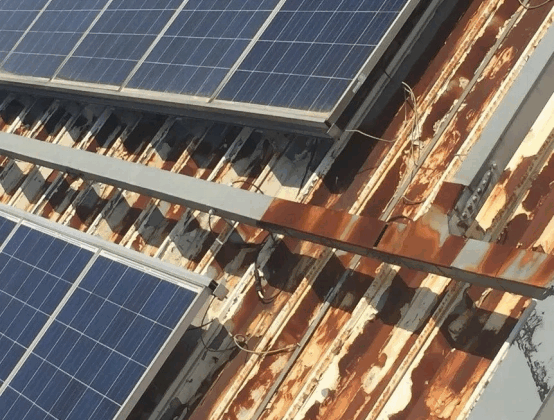
Metal factory roofing tiles (mostly color-coated steel sheets, galvanized sheets, aluminum-magnesium-manganese sheets, etc.) are prone to corrosion. This is the result of a combination of factors, including the characteristics of the metal materials, the specific environment of the factory area, defects in the roof structure, and a lack of subsequent maintenance. From a material perspective, steel (iron-based) is easily subjected to electrochemical corrosion in the presence of water and oxygen, forming loose rust. The natural oxide film on the surface of aluminum is also easily destroyed by acids and alkalis, providing “innate conditions” for corrosion. From a factory environment perspective, processes such as pickling, electroplating, and welding in metal production generate acid mist, alkali mist, and metal dust. Coastal factories also experience salt mist. These corrosive media adhere to the surface of the roofing tiles, not only damaging the protective layers such as the color coating and galvanized layer, but also accelerating electrochemical corrosion, making the corrosion rate several times faster than in ordinary environments. From a roof structure and construction perspective, poor drainage leading to localized water accumulation, galvanic corrosion caused by contact between dissimilar metals (such as aluminum-magnesium-manganese sheets and carbon steel supports), and damage to the protective layer caused by tool impacts during installation all contribute to corrosion. “Localized corrosion hotspots” become the entry point for corrosion; if surface contaminants are not cleaned, aged sealant not repaired, or anti-corrosion coating not applied in time, the initial minor corrosion will continue to worsen, eventually leading to rust and perforation of the roof tiles, significantly shortening their service life.
The core advantage of using Himei waterproof roofing tiles with double-sided anti-corrosion function lies in its ability to address the pain points of traditional roofing tiles—insufficient single-sided protection, susceptibility to rust from the back, and short lifespan—specifically for the high-corrosion, high-humidity environments of metal plants. This is achieved through four key aspects: protection, durability, economy, and adaptability. The specific advantages can be summarized as follows:
From a protection perspective, its double-sided anti-corrosion design forms a comprehensive protective barrier, completely isolating corrosion risks. The front side resists external corrosive media such as acid mist, alkali mist, and metal dust generated during metal plant production, preventing direct erosion of the coating and substrate. The back side isolates the roof from condensation and pollutants generated by rusted steel purlins, preventing the “back-side corrosion first, gradual penetration” problem of traditional tiles. This is particularly suitable for the special scenario of metal plant roofs where “both sides are easily exposed to corrosion sources,” significantly improving the protection range and effectiveness compared to single-sided anti-corrosion tiles.
From a durability perspective, the double-sided anti-corrosion process significantly extends the service life of the roofing tiles. Corrosion of metal factory roofing tiles often begins on the weakest point (such as the back without a protective layer) and gradually spreads to the entire surface. Himei waterproof tiles, however, possess stable anti-corrosion performance on both sides, resisting electrochemical corrosion and pitting corrosion in high-temperature and high-humidity environments. This reduces perforation and cracking caused by localized corrosion, and their service life is typically more than 50% longer than ordinary single-sided anti-corrosion tiles, reducing the inconvenience of frequent roofing tile replacements in metal factories.
Economically, the double-sided anti-corrosion design reduces long-term maintenance costs. Firstly, a longer service life means reduced direct costs for tile procurement and replacement. Secondly, comprehensive protection avoids indirect losses such as damage to indoor equipment and production stoppages caused by roof corrosion and leakage—a daily loss for a metal factory due to roof leakage can far exceed the cost of purchasing the roofing tiles. Double-sided anti-corrosion tiles effectively mitigate such risks while reducing the frequency of routine inspections and localized repairs, thus lowering maintenance manpower requirements.
In terms of adaptability, Himei waterproof shingles’ double-sided anti-corrosion properties can also adapt to the complex structure of metal factory roofs. Metal factory roofs often have nodes such as skylights, pipe penetrations, and gutters. These areas are prone to water and dirt accumulation, resulting in a higher risk of corrosion. However, its double-sided anti-corrosion layer can still maintain stable protection at these nodes. With the help of special sealing accessories, it can solve the pain points of “easy corrosion and difficult maintenance” at these nodes. In addition, if the metal factory roof adopts a “bottom-supported” or “sandwich” structure, the anti-corrosion layer on the back can also work in synergy with the internal insulation and moisture-proof layer to improve the stability of the overall roof system and adapt to the needs of different types of metal factory buildings.