
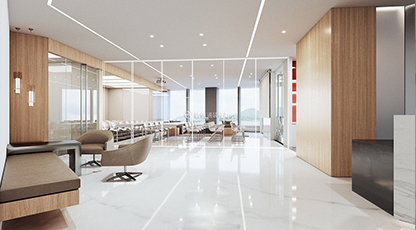
Film-faced plywood is an aluminum alloy substrate coated with a film. High-gloss or iridescent film is used, and the surface is then coated with an adhesive. Film-faced plywood offers a vibrant luster and is available in a wide variety of colors. It is durable (weather-resistant, corrosion-resistant, chemical-resistant), stain-resistant, and has excellent UV resistance. Different film-faced plywood substrates have varying base materials and thicknesses, as do the film coating materials and thicknesses.
Roller-coated plywood is made by degreasing and chemically treating the aluminum substrate, then applying a coating by roller coating and drying to cure. The base material is the same as the film-faced plywood. The roller coating process controls the plywood’s precision, flatness, and any unevenness or wrinkles caused by traditional methods, resulting in uniform, delicate, soft, and vibrant colors for architectural decoration. The quality of the coating varies depending on the coating and the method used. The film thickness is thinner than that of film-faced plywood, at only 0.04mm. Therefore, standard roll-coated plywood is generally 0.1mm thinner than film-faced plywood of the same specification. However, due to the roller coating process, it is less susceptible to color variation than film-faced plywood. Film-coated boards have softer reflective properties, are easy to clean, and are resistant to scratches and discoloration, though the heat resistance is relatively high.
Key features of roll-coated boards: 1. Excellent temperature resistance. Aluminum melts at 660°C, far below the melting point of ordinary temperatures. 2. Non-yellowing. The roll-coated paint, which uses a chromium-free treatment solution, compensates for the discoloration of film-coated boards. The roll-coated paint contains reactive chemical molecules that form a protective layer on the surface. These reactive molecules are stable and easily recyclable. 3. Corrosion resistance. The dense oxide film on the surface provides strong adhesion, oxidation resistance, acid and alkalinity resistance, corrosion, decay, and UV exposure. 4. Uniform and long-lasting color. The color is uniform, delicate, and soft, vibrant, avoiding the individual color variations associated with traditional spray coatings. Regardless of the size of the ceiling, the color remains consistent and looks fresh. 5. Combining rigidity and toughness, the board surface is highly robust and can be freely cut, striped, bent, pressed, drilled, fastened, and edge-compressed. Roller-coated flooring is a type of flooring that is coated with a light-curing coating using a roller-coating machine. Roller-coating is characterized by its thin surface, excellent adhesion, and high sealing performance.