
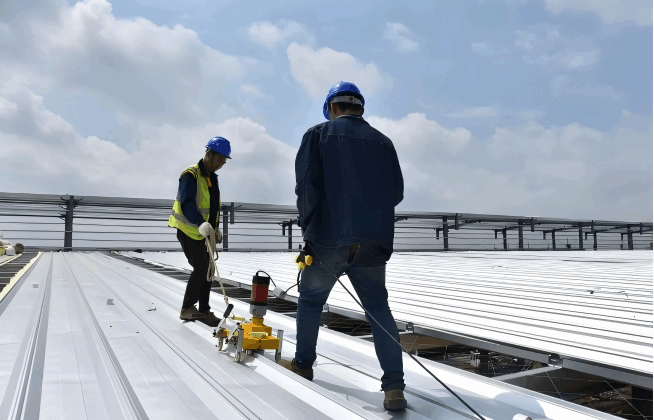
Steel structure factory buildings have become a top choice in the industrial sector due to their light weight, large span, and fast construction. However, it also has its “fragile” side:
Metal roofs are prone to corrosion: Contact with acid rain, salt spray, or workshop exhaust gases (such as in electroplating plants and chemical plants) can easily cause the metal layer to rust, shortening its lifespan;
Steel structure factory renovation
Thermal expansion and contraction deformation: Steel structures are sensitive to temperature, expanding in summer and contracting in winter. Ordinary tiles (cement roofs, corrugated steel roofs) are prone to cracking, leading to leaks;
High energy consumption: Metal roofs absorb heat strongly and have a high thermal conductivity. In summer, the roof temperature is 10-15°C higher than the ambient temperature, putting great pressure on air conditioning;
Difficult maintenance: The paint on the surface of traditional tiles (corrugated steel tiles, ordinary metal tiles) is prone to aging and corrosion, causing leaks. Local repairs are not possible; large-scale replacement of roof tiles is required, affecting normal factory production;
High hidden costs: The average lifespan of conventional roof tiles is 8-10 years. Generally, corrosion and leaks will gradually occur within 10 years. Repairs require replacing the entire tile surface, which is difficult and expensive.
Haimei Waterproof Roofing Solutions for Steel Structures
- Corrosion Resistance: Giving Your Roof a “Protective Armor,” No Rust for 25 Years
Steel structure factories are most afraid of rust! The surface waterproof membrane of TPO/PVC waterproof roofing sheets is resistant to acid, alkali, and salt spray corrosion (withstanding pH environments of 2-12), effectively isolating the metal roof from corrosive media. Furthermore, during production, we add an additional highly weather-resistant and anti-corrosion layer to both sides of the sheets, providing double anti-corrosion protection for the roof.
- Deformation Resistance: Expanding and Contracting with the Steel Structure, No Cracks for 25 Years!
Steel structures are temperature-sensitive. In areas with large temperature differences (such as Northeast and Northwest China), roofs are prone to cracking due to thermal expansion and contraction. TPO and PVC membranes have an elongation at break of >500%, high elasticity, and can conform to the expansion and contraction of the metal roof like a “rubber band,” solving the problem of cracking and leakage. The combination of steel plate and waterproof membrane offers both strength and ductility. Under temperature stress, it can elastically expand and contract rather than plastically deform, with a temperature range of -50℃ to 120℃, making it ideal for large-span steel structure factories.
- Energy Saving and Cooling: Saves 15% on electricity in summer, essentially “air conditioning” for the factory!
White TPO/PVC membrane has a high solar reflectivity (>80%), reflecting over 80% of solar radiation heat; simultaneously, the 1.8mm thick TPO/PVC membrane has a low thermal conductivity. Actual measurement data shows that in summer, the temperature of Himei waterproof tile roofs is 8-12℃ lower than that of ordinary color steel tiles, directly reducing air conditioning energy consumption by 10%-15%. For high-energy-consuming factories (such as steel mills and foundries), this can save hundreds of thousands of yuan in electricity bills annually!
- Fire Safety: B1-level flame retardant, providing “insurance” for the factory!
Steel structure factories often store equipment and raw materials, making fire prevention a bottom line. TPO and PVC roofing membranes are inherently fire-retardant (reaching B1 fire rating), and when combined with a galvanized steel frame (A-grade fire resistance), they can slow the spread of even a localized fire, buying time for rescue efforts and meeting the requirements of the “Code for Fire Protection Design of Buildings.”
- Weldability: Giving the factory a “raincoat,” 25 years of leak-proof protection
Himi waterproof roofing tiles utilize a hot-air welding process, achieving a peel strength of over 9.0 N/mm after the weld (ordinary corrugated steel sheets are prone to loosening when nailed). Like a “zipper,” they fit seamlessly, preventing leaks even in heavy rain. Besides joints, screw fixings, gutters, skylights, parapet walls, and other areas prone to leaks are all covered with welded waterproof membrane, ensuring a leak-free roof. Even if localized damage occurs later, it can be easily repaired by welding the damaged area with the same waterproof membrane, eliminating hidden costs.
Steel structure factory buildings require durability, cost-effectiveness, and peace of mind, and TPO/PVC Himei waterproof shingles solve all these problems with their multiple advantages, including corrosion resistance, deformation resistance, energy saving, and fire resistance. It’s not just a shingle; it’s a “long-term insurance” solution for the factory building—25 years of leak-proof, rust-free, and energy-saving maintenance.