
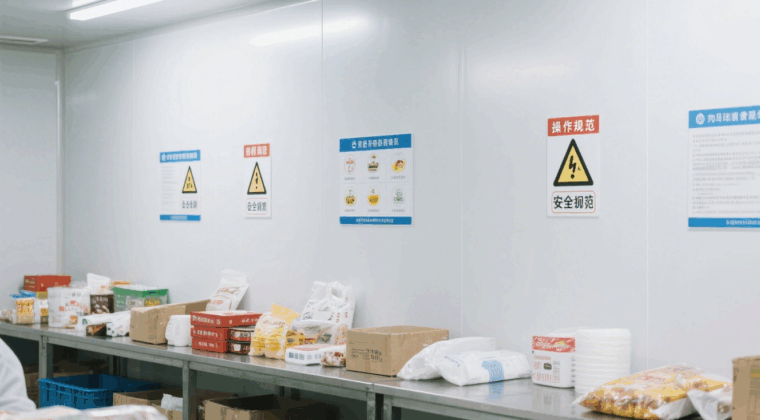
In addition to cleanliness, cleanrooms must also meet requirements for fire resistance, moisture resistance, and thermal insulation. Traditional materials require additional multi-layered auxiliary structures (such as brick walls + insulation layers + fireproof boards), while pharmaceutical-grade cleanroom panels offer “multi-functionality in one panel,” significantly simplifying construction:
Integrated Fire Resistance and Thermal Insulation
The core material of pharmaceutical-grade cleanroom panels can be selected according to fire resistance ratings (such as Class A rock wool core material or Class B1 polyurethane core material), while also possessing excellent thermal insulation performance (thermal conductivity as low as 0.03 W/(m・K)). For example:
Medical operating rooms need to simultaneously meet fire resistance (to avoid fire risks) and thermal insulation (to maintain a constant room temperature). Pharmaceutical-grade cleanroom panels do not require additional insulation layers or fireproof boards; direct installation meets the standards.
Traditional brick walls require first building the wall, then applying insulation cotton and installing fireproof gypsum board, a cumbersome process prone to interlayer detachment.
Moisture-proof and corrosion-resistant, adaptable to special environments
The substrate and surface polymer layer of pharmaceutical-grade cleanroom panels possess extremely strong moisture-proof and corrosion-resistant capabilities:
In food processing rooms (high humidity + frequent disinfection), using pharmaceutical-grade cleanroom panels avoids the problems of moisture absorption and mold growth found in traditional gypsum boards, and efflorescence on brick walls;
In electronics workshops (containing corrosive gases from etching processes), pharmaceutical-grade cleanroom panels can resist chemical corrosion, while ordinary color steel panels will rust and fail within 3-5 years.