
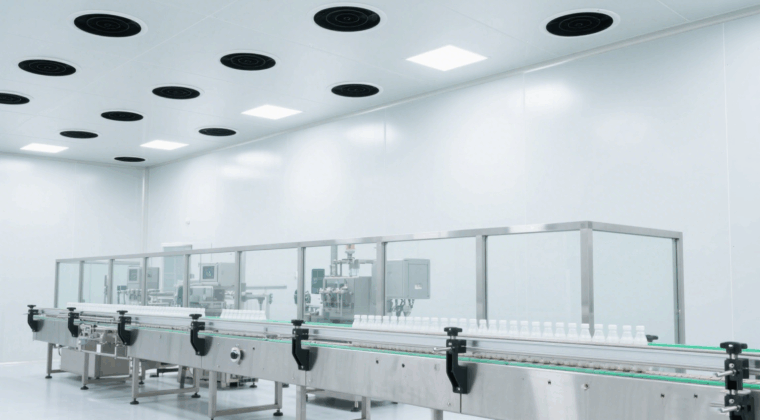
Traditional industrial plant wall materials (such as ordinary color steel plates and painted walls) often fall short in pharmaceutical settings:
- Ordinary metal plates have rough surfaces that easily trap dirt, requiring repeated wiping and even sanding for cleaning, which is time-consuming, labor-intensive, and may leave cleaning agent residue;
- Concrete walls easily absorb moisture and breed mold, making it difficult to meet microbial limits;
- Ordinary coatings have poor chemical resistance and are easily peeled off after splashing medicine or being corroded by cleaning agents, thus becoming a source of pollution…
The emergence of pharmaceutical purification panels is precisely to solve these critical pain points. Using a metal substrate as a base, a functional purification membrane is combined with the metal substrate through a composite process, forming a three-dimensional protective steel plate that provides both physical protection and chemical resistance.
- Easy to Clean
The pharmaceutical purification panel has a smooth and dense surface with excellent hydrophobicity (maximum water absorption rate less than 5%) and oil repellency; its extremely low coefficient of friction (0.15-0.17) prevents dust and scale buildup, providing excellent stain resistance. Surface dust can be cleaned directly with water without residue.
- Resistant to Disinfection
In hospitals, laboratories, and other similar locations, indoor environments are disinfected multiple times daily. Ordinary wall panels struggle to withstand such frequent disinfection. Experimental results show that corrosive agents cannot damage pharmaceutical-grade cleanroom panels, thus protecting the walls.
- Antibacterial
Ordinary materials rely on periodic disinfection (such as alcohol or ultraviolet light) for antibacterial properties. Pharmaceutical-grade cleanroom panels actively inhibit bacterial growth by disrupting bacterial cell membranes or DNA through an antibacterial film on their surface. Testing shows that these panels achieve a 99.9% kill rate against Escherichia coli and Staphylococcus aureus within 24 hours, and an inhibition rate of over 95% against molds (such as Aspergillus niger). They are particularly suitable for high-humidity, mold-prone raw material warehouses or extraction workshops.
- Resistant to Acid and Alkali Corrosion
In pharmaceutical manufacturing, splashes or residues of hydrochloric acid, sodium hydroxide, ethanol, and acetone are common. Ordinary coatings easily swell and peel off when exposed to organic solvents. Pharmaceutical-grade cleanroom panels have undergone multiple chemical resistance tests: 240 hours of immersion in acid and alkali solutions, ethanol, and hydrogen peroxide showed no change, while ordinary polyester only lasted 50 hours.
- Scratch Resistance
Cleanrooms experience frequent movement of trolleys and equipment, making walls easily scratched. The metal substrate thickness of the cleanroom panels is typically ≥0.8mm (compared to only 0.5mm for ordinary color steel panels), and the surface film hardness can reach 2H-3H (pencil hardness, ordinary paint is only HB), capable of withstanding 1000 cycles of friction under 5N pressure (industry standard is 500 cycles).
- High Flatness
The flatness error of the cleanroom panels is ≤1mm/2m (compared to >3mm for ordinary color steel panels). This not only meets the functional requirements of pharmaceutical workshops for “dust-free dead corners” but also aligns with the modern pharmaceutical company’s requirements for “industrial aesthetics”—while GMP does not mandate aesthetics, a clean environment directly reflects the company’s management level. In international certifications such as FDA and EMA, “flat and deformation-free walls” are also key items for on-site inspections.