
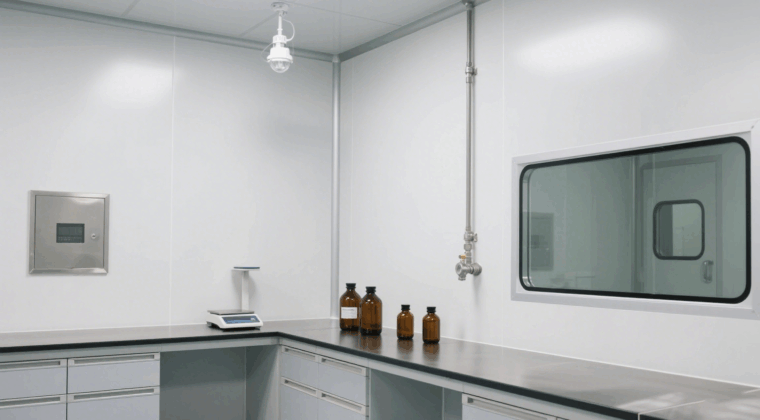
In cleanrooms (such as pharmaceutical workshops, food processing workshops, hospital operating rooms, and electronic cleanrooms), cleanroom panels serve as a core enclosure material. Their ease of cleaning is a crucial attribute for ensuring the cleanliness level, production safety, and operational compliance of the space. This requirement is not an additional constraint but is determined by the specific functional needs of the cleanroom, the logic of pollutant control, and industry standards. The specific reasons can be elaborated from the following four dimensions:
I. Core Need: Maintaining “Dynamic Cleanliness” and Preventing Pollutant Accumulation
The core objective of a cleanroom is to control the concentration of airborne particles (such as dust, microorganisms, and suspended particles) and chemical pollutants to achieve a specific cleanliness level (such as Class 100, Class 1000, or Class 10,000). As the primary covering material for walls and ceilings, cleanroom panels are the most likely “carriers” for pollutants to adhere to:
If the surface of the cleanroom panel is rough and difficult to clean, airborne particles and moisture will gradually deposit on the surface, forming a “pollutant enrichment layer.” These enriched pollutants may re-diffuse into the air through airflow disturbances and personnel contact, directly disrupting the cleanliness balance of the space, leading to product contamination (such as pharmaceuticals and chips) or increasing the risk of infection in medical settings.
Easy-to-clean purification panels (such as smooth, non-porous panels) can quickly remove attached contaminants with simple wiping (e.g., using disinfectant or a lint-free cloth), avoiding the vicious cycle of “contaminant accumulation – diffusion – secondary pollution” and ensuring the space is always in a “dynamically clean” state.
II. Functional Necessity: Adapting to the “High-Frequency Cleaning and Disinfection” Scenarios of Purified Spaces
Cleaning and disinfecting purified spaces is not just “periodic cleaning,” but a high-frequency, high-intensity, and multi-method daily maintenance process. Ease of cleaning directly determines maintenance efficiency and effectiveness:
High-Frequency Cleaning Needs: Production workshops in industries such as food and pharmaceuticals require daily or even shift-based cleaning; hospital operating rooms require immediate and thorough disinfection after surgery. These scenarios demand extremely high cleaning efficiency—if the purification panels are difficult to clean, it will significantly increase cleaning time and labor costs, and may even affect production or treatment progress.
Adaptability to Diverse Disinfection Methods: Purified spaces commonly use chemical disinfectants (such as chlorine-containing disinfectants and alcohol), high-temperature and high-pressure rinsing, and ultraviolet irradiation for disinfection. Easy-to-clean cleanroom panels must simultaneously meet characteristics such as “resistance to disinfectant corrosion,” “water-repellent surface (reducing water residue),” and “no dead corners (avoiding disinfection blind spots)” to ensure that the disinfection process thoroughly kills surface microorganisms, rather than incomplete disinfection due to the characteristics of the panel material.
For example, if the cleanroom panel surface has gaps or depressions, disinfectant cannot penetrate, leading to the growth of bacteria and mold, creating “cleanliness dead corners,” which is unacceptable in pharmaceutical GMP workshops or hospital ICUs.
III. Compliance Bottom Line: Meeting Mandatory Industry Standards and Quality Certification Requirements
Almost all industry regulations related to clean spaces have clear mandatory requirements for the “ease of cleaning” of enclosure materials. This is the bottom line for enterprise production and operation:
Pharmaceutical Industry: The Good Manufacturing Practice (GMP) for Pharmaceuticals clearly requires that “the inner surfaces of clean areas (walls, floors, ceilings) should be flat, smooth, without cracks, with tight joints, and without particulate matter shedding, facilitating cleaning and disinfection.” If the cleanroom panels are not easy to clean, the enterprise will fail GMP certification and directly lose its production qualification.
Food Industry: The General Hygiene Standard for Food Production (GB 14881-2023) stipulates that “workshop walls and partitions should use non-toxic, odorless, mildew-proof, non-flaking, and easy-to-clean materials” to prevent food contamination from wall pollutants and ensure food safety.
Medical Industry: The Technical Specification for Clean Operating Room Buildings in Hospitals (GB 50333-2013) requires that the enclosure materials for clean areas should have “smooth, flat, dust-free, and easy-to-clean surfaces,” directly impacting surgical infection control.
IV. Cost Control: Reducing Long-Term Maintenance and Consumption Costs
Ease of cleaning may seem like a “material characteristic requirement,” but it directly affects the long-term operating costs of clean spaces:
Reducing Cleaning Consumables and Labor: Difficult-to-clean materials require more disinfectants and cleaning tools, and cleaning time is longer (e.g., rough surfaces require repeated wiping, and crevices require special tools for cleaning), resulting in extremely high accumulated labor and consumable costs over time.
Extending the lifespan of the panels: If contaminants adhere to the surface of the panels for a long time, it may cause corrosion (such as chemical contaminant penetration) and mold growth (such as mold growth from dust in humid environments), leading to premature replacement of the panels. Easy-to-clean panels can remove contaminants promptly, reducing material waste and extending their lifespan.
Avoiding the risk of “production stoppage for cleaning”: Some cleanrooms (such as electronic chip factories) require complete production stoppage for thorough cleaning if their cleanliness standards are not met. Easy-to-clean panels can maintain cleanliness through quick daily cleaning, avoiding production losses due to untimely cleaning.
Summary: Ease of cleaning is a “core functional attribute” of cleanroom panels.
The essence of cleanrooms is “controlling contaminants through human intervention,” and as the “first line of defense” in these spaces, the ease of cleaning of cleanroom panels directly determines the efficiency, effectiveness, and compliance of contaminant control—it’s not just a matter of “easy cleaning,” but also a “hard threshold” for ensuring product quality, medical safety, and production compliance. Therefore, high-quality cleanroom panels in the industry all use “smooth surface, no pores, disinfection resistance, and easy wiping” as core technical indicators.