
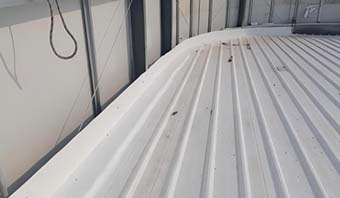
The acid and alkali resistance of TPO composite metal tiles is primarily due to the chemical structure and carefully designed formulation of their core components—polyolefins (primarily polypropylene and polyethylene). The reasons are as follows:
- Inert Polyolefin Backbone:
TPO’s core materials are polypropylene (PP) and polyethylene (PE), both saturated, non-polar polymers.
Their molecular backbones are primarily composed of carbon-carbon (C-C) and carbon-hydrogen (C-H) bonds, making them chemically very stable and inert.
This structure lacks reactive groups that readily react with acids (H⁺) or bases (OH⁻), such as esters, amides, and double bonds, commonly found in other plastics like PVC and certain rubbers.
Therefore, common acids (such as sulfuric acid, hydrochloric acid, and nitric acid) and bases (such as sodium hydroxide and limewater) have difficulty disrupting their stable C-C and C-H bonds, preventing hydrolysis, saponification, or other chemical reactions.
- Non-polarity:
Polyolefins are non-polar materials. This means their molecules lack a distinct separation of positive and negative charges.
Acids and bases are typically polar or ionic substances (forming H⁺ or OH⁻ ions when dissolved in water).
According to the principle of “like dissolves like,” non-polar polyolefins have a natural repulsion and low affinity for polar acid and alkaline solutions, making it difficult for these substances to penetrate, adsorb, or swell TPO materials.
- No Migrating Additives:
Unlike materials like PVC, high-quality pure TPO formulations typically contain no or minimal amounts of low-molecular-weight plasticizers.
Plasticizers can easily migrate, volatilize, or be extracted by chemicals, causing the material to become brittle and degrade performance. Some plasticizers may also react in acidic and alkaline environments.
TPO’s performance is primarily regulated by the polymer blend and fillers (such as talc and carbon black). These fillers themselves are chemically stable and resistant to acid and alkali reactions.
- Formula Optimization:
Although the base polyolefin is very stable, stabilizers (antioxidants, light stabilizers) and fillers are added to TPO to meet requirements for weather resistance and processability.
High-quality TPO formulations select chemically inert stabilizers and fillers. These additives will not decompose or produce harmful byproducts in acidic or alkaline environments, thereby ensuring the overall chemical resistance of the membrane.
Key Points:
Chemical Inertness: Stable C-C/C-H backbone with no reactive groups.
Non-Polarity: Naturally repellent to polar acidic and alkaline ions, resisting penetration and adsorption.
Plasticizer-Free: Avoids performance degradation due to small molecule migration or reaction.
Stable Formula: Chemically resistant additives and fillers are selected.
Thus, thanks to its polyolefin nature and optimized formula, TPO waterproofing membranes can withstand long-term corrosion in a variety of acidic and alkaline environments, demonstrating excellent durability in chemically exposed locations such as chemical plants, sewage treatment plants, and basements, as well as on roofs exposed to acid rain. Of course, the specific chemical resistance level needs to refer to the product technical data sheet, because the performance of TPO from different manufacturers and with different formulations will vary, and the resistance to strong oxidizing acids (such as concentrated sulfuric acid and nitric acid) or certain organic solvents may be limited.