
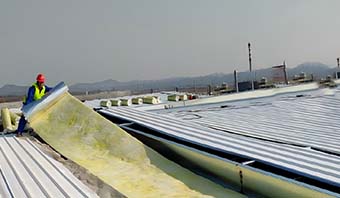
TPO composite metal roofing tiles are widely used in modern buildings, particularly flat roof systems, due to their excellent weather resistance, chemical stability, and environmental friendliness. Their thermal insulation properties (more precisely, their reflective and heat-dissipating properties) are a key additional benefit, crucial for building energy efficiency and improving indoor environmental comfort.
- High Solar Reflectivity:
Key Feature: The TPO membrane used on the surface of waterproof tiles is typically manufactured in white or light gray (bright white is the most common). This light-colored surface has a very high solar reflectivity.
How it works: It reflects the majority of solar radiation (primarily visible and near-infrared light) that strikes the roof surface directly back into the atmosphere, rather than absorbing it and converting it into heat.
Statistical Performance: The solar reflectivity of new, clean white TPO membranes is typically between 0.70 and 0.85 (reflecting 70%-85% of sunlight). This is significantly higher than that of traditional black, asphalt-based membranes, which typically have a reflectivity of only 0.05-0.15.
- High Infrared Emissivity:
Key Feature: TPO materials themselves and their light-colored surfaces typically have high thermal infrared emissivity.
How it works: Even if the membrane surface absorbs some heat, causing it to heat up, it effectively and quickly dissipates (radiates) this heat back to the cooler sky (especially on clear nights) as long-wave infrared radiation. This helps to quickly cool the roof after sunset.
Data Performance: The thermal emissivity of TPO membranes is typically above 0.85 (meaning that they effectively radiate more than 85% of the absorbed heat).
- Comprehensive Metric: Solar Reflectance Index:
To more comprehensively evaluate the cooling performance of roofing materials, the industry uses the Solar Reflectance Index (SRI). This metric combines a material’s solar reflectivity and thermal emissivity.
Excellent Performance: Due to its high reflectivity and emissivity, white TPO membranes typically have an SRI value exceeding 100 (sometimes reaching 110 or higher). According to ASTM E1980, standard black paint has an SRI of 0, and standard white paint has an SRI of 100. Therefore, a TPO SRI >100 indicates superior cooling performance compared to standard white paint.
Comparative Advantage: This is significantly higher than black EPDM (ethylene propylene diene monomer) membrane (SRI typically <20) and dark modified asphalt membrane (SRI close to 0).
- Thermal Conductivity of the Material:
TPO itself is a thermoplastic material with relatively low thermal conductivity. However, the membrane itself is very thin (typically 1.2mm-2.0mm), so its thermal resistance as an insulation material is very limited.
Core Contribution: TPO membrane’s “insulating” effect is primarily due to its ability to reflect and radiate heat, rather than providing significant conductive thermal resistance like foam insulation. It achieves energy savings primarily by reducing heat entry into the building, rather than preventing heat conduction through the material.
Main Benefits of Thermal Insulation:
- Significantly Reduced Roof Surface Temperature: In summer sunlight, the surface temperature of a white TPO roof can be 30°C to 50°C or more lower than that of a darker roof. This significantly reduces thermal stress on the roofing material itself, extending its service life.
- Reduced building heat gain and lower air conditioning energy consumption: Lower roof surface temperatures mean significantly less heat transfer into the building. This directly reduces the air conditioning and cooling load on the building’s top floor, significantly saving 10%-30% in air conditioning operating costs (depending on climate, building type, and insulation).
- Improved indoor comfort: Top-floor rooms experience more stable and cooler temperatures, especially when air conditioning is unavailable or insufficient.
- Reduced urban heat island effect: Using highly reflective, light-colored roofing materials (such as TPO) over large areas helps lower ambient temperatures and mitigate the urban heat island effect.
- Extended membrane life: Lower operating temperatures reduce the rate of thermal aging, extending the service life of TPO membranes.